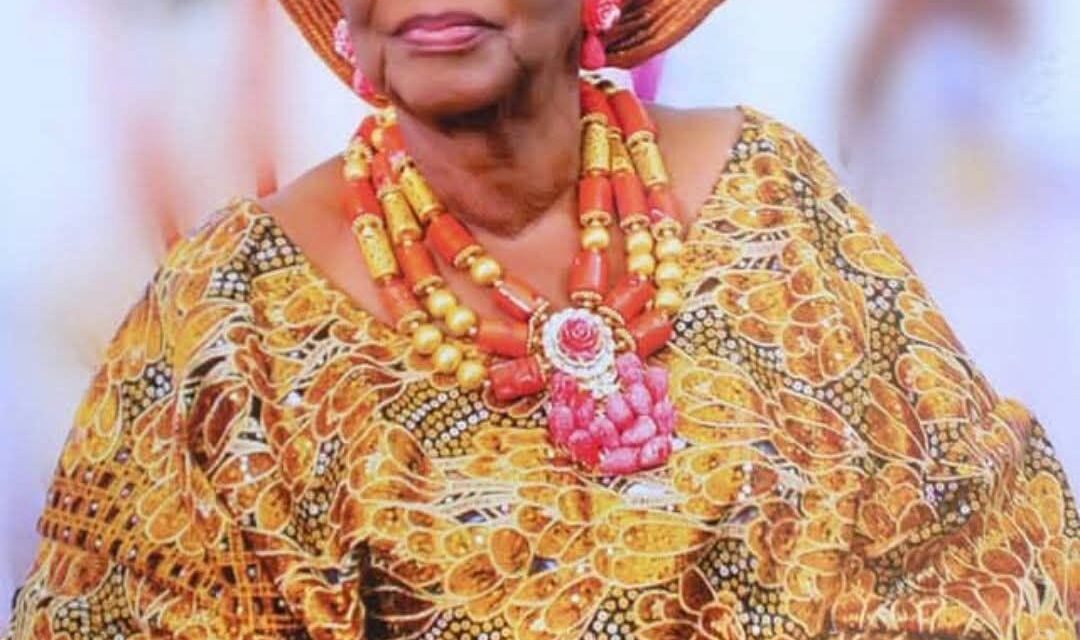
Yeye Owa (Dame) Eunice Olayinka Obaleye (MON), beyond a traditional norm in some families with the major belief that a girl is only meant for childbearing and the kitchen, exemplified an African proverb: “Educating a male child is like educating a person, while educating a girl is like educating a family and a whole nation.” Yeye Owa, Dame Obaleye lives on as a catalyst and counter-cultural force to ‘an old way of thinking that says a woman only needs enough knowledge to cook, clean, raise children, and manage a home. That idea sounds traditional to some people, but it collapses the moment you ask a serious question: is a woman only a domestic worker, or is she a full human being with intellect, ambition, rights, and social value beyond the walls of a kitchen?’ Yeye Owa, Dame Obaleye remains a testament that women’s education does not end in the kitchen or be defined by domestic usefulness alone. Indeed, a kitchen is part of life, but it should not define the size of a woman’s future, just as ‘education is not just about preparing somebody for chores. Education builds literacy, reasoning, confidence, problem-solving, and the ability to make decisions.’ Sadly, tradition is not the same as the truth. The kitchen is an important part of life, but it is not the full measure of a woman’s purpose.
Yeye Owa, Dame Obaleye’s formal education became a reality when her maternal grandparent persuaded her father to allow her to attend school. Her father, a trader, wanted her to take after him, and she worked as an attendant in his shop at Abeokuta before she found her way to school in Ilesa and was enrolled as a primary school pupil in Iregun. She explained that her dream of becoming educated was short-lived when her father came to Ilesa to withdraw her from school, on the excuse that the young wife he had just married could not cook his special menu. That was how she returned to Abeokuta, but the little education she had acquired would later become useful to her as a global businesswoman and God’s kingdom steward. She understudied her father so much that whenever he travelled to Lagos to buy goods, she was in charge of sales in his shop. As time went on, she started a small business used to hawk goods.
She married her husband, John Obaleye, according to native law and custom, and they lived in Idanre, Ondo State, where she resumed trading, producing soaps in commercial quantities and investing in coal with profits realised from the soap business. She also invested in textiles. Her journey into manufacturing foams and mattresses began after a chance encounter with a Hausa-Fulani hawker of grass mattresses. According to her, she ‘bought some which I resold and made a profit of N20 from the sale. Within a week, I bought more grass mattresses and sold them all. I took advantage of the good patronage and convinced the Hausa hawker to make thread mattresses, which I bought in large quantities. That was how I became the dealer of the most popular mattress in the 60s.’
However, her business suffered a setback when rats invaded her shop and ate the mattresses. She applied rat poison, but it didn’t check the menace. She was then advised to put cats in the shop, and that was how her business was saved from destruction. When her business picked up again, she went to Ibadan, Oyo State, to buy goods from a company called Tola Foam owned by the late Chief Adeola Odutola. Due to some business misinformation with Chief Odutola, Yeye Owa, Dame Obaleye started patronising another foam firm for about nine years, until it occurred to her that she could start producing something similar. She started producing box foam, and in 1981, she went to the United Kingdom to buy machines that would enhance her production. In those days, one didn’t require a visa to travel to London. She recalls that the dollar was 60 cents to N1, and it was N1 to £1 then. She was doing so well that her fame spread to neighbouring towns and cities because of the foam plant she established in Ilesa, Osun State. She took advantage of the boarding school system, which was the vogue at the time, to become a major supplier of foams. Before long, she ventured into the production of iron beds in commercial quantities.
In 1989, the foam factory burned three times in one month. The fire incident, which occurred at the factory in 2012, was also very bad. She lost many things, and she later invested in other business initiatives, namely, the hospitality and oil and gas sectors. Yeye Owa, Dame Obaleye, was not a Christ Army without a mark. According to her, the lowest moment in her life was when her son died. She felt suicidal, but the grace of God prevented me from taking my own life.
In the contemporary context of global reawakening and other global policy spaces, the name and legacy of Yeye Owa, Dame Obaleye, summons us to ensure that girls and young women are present, not just as flower girls to decorate panels, but as powerful voices, decision-makers, and leaders whose perspectives not only shape industrial financing policies but also missional and community development. For Yeye Owa, Dame Obaleye, truly, girls don’t just belong in the kitchen. They belong in every room where policies are written, resources are allocated, and futures are decided.
Hailing from Egbe Idi, Ilesa, Osun State and born to Mr and Mrs John Olabode in Abeokuta, Ogun State, on June 4, 1938, Yeye Owa Dame Obaleye was a trailblazing entrepreneur who built a chain of industries in Ijesaland and beyond. Dame Obaleye explained that ‘the love for adventure and desire to break new ground in trade’ took her father, John Olabode, to Abeokuta even though he had built a house in Egbe Idi. He was a trader, and he established a commercial shop at Itoku, in the heart of Abeokuta.’ According to her, she loved education and looked forward to it, but her father thought otherwise. My pleas to attend school as my peers fell on deaf ears as my father retorted that female children would end up in the kitchen.’ Yeye Oba Dame Obaleye represents a voice to stop the discrimination and hypocrisy against the feminine gender and build a nation of educated leaders together, regardless of gender. She represents the potential of our women beyond the kitchen.
The world and Christian Methodist community mourn the passing of an extraordinary matriarch, Yeye Owa, Dame Obaleye (MON), widely known as Yinka Oba Foam and the founder and chairperson of Yinka Oba Foam Nigeria Limited (YOFOAM), Ilesa. She built Yinka Oba Foam into one of Nigeria’s leading indigenous foam and manufacturing brands from the ground up, and her other business interests also spanned across manufacturing and hospitality, including Oba Paints, Kings Hospitality Ltd, Yeunice Industries Limited, and Joy Dreams Limited.
Yeye Owa, Dame Obaleye, received several awards from the Manufacturers Association of Nigeria (MAN). In 1992, she was honoured with an Honorary Doctor of Business Administration degree from Staton University, Florida, United States of America (USA). In recognition of her community impact, she was awarded a national honour as Member of the Order of the Niger (MON) in 2012. Through her trust in God and resilience, she overcame major early business hardships, including surviving multiple factory fires and severe personal security challenges. She was kidnapped on November 19, 2013, and, by the grace of God, survived the 18-day traumatic incident in Osun State that tragically claimed the life of her driver, Alhaji Kamarudeen Adebisi. However, despite these challenges, she remained steadfast, rebuilding her enterprises and inspiring generations of entrepreneurs, particularly women, across Nigeria. In pursuit of her deep commitment to women’s empowerment, she donated an integrated fistula/obstetrics centre at Wesley Guild Hospital in Ilesa.
She was a pillar of strength, love, and compassion, who left an indelible mark on the lives of everyone she touched. She lived a life of purpose, dedication, and selflessness. As a devoted wife, mother, grandmother, and matriarch, she embodied love, kindness, and generosity. Her humble beginnings, resilience, rise to spiritual and corporate prominence, personal warmth, unmatched wisdom, grace under pressure, and compassion inspired countless individuals, and her legacy of impactful service and love will continue to inspire generations to come.
My first encounter with Yeye Owa, Dame Obaleye, was when I was serving as the pioneer General Secretary of the Great Reformers Club, Osu, GRC (1984-1989). The history and story of the Great Reformers Club, Osu, Osun State, Nigeria, a sociocultural association, is about community-development-minded and progressive school-certificate and undergraduate Osu young people. For the GRC, our charity began at home, and reforming was the first step toward self-reformation and empowerment. Self-reformation has contributed to our enduring vitality to date, with members excelling as graduates, doctors, professors, teachers, executive chairpersons of companies, lawyers, military officers, and bishops. As part of our vision to empower Osu youths over forty years ago, we organised a tour to Yinka Oba Foam, along Ijebu-Jesa Road, Ilesa. Yeye Owa, Dame Obaleye, welcomed me with open arms and immediately approved our request. On the day of the excursion tour with over 40 youths, Yeye Owa, Dame Obaleye, was physically on the ground to welcome us, taking us around the facilities with unmatched hospitality.
Yeye Owa, Dame Obaleye, a Knight of John Wesley, Methodist Church Nigeria, passed into glory on Sunday, 21st of June 2026, barely two weeks after her 88th birthday. It is noted that, as ‘a titan of industry, a devoted philanthropist, and a revered cultural figure, her transition marks the end of an extraordinary era of service, leadership, and community development.’ Dame Obaleye’s impact on her community, family and church was immense. She was a devoted philanthropist, supporting various charitable causes and organisations throughout her life. She was a pillar of strength and wisdom. She was a guiding light to her family, offering words of wisdom, comfort, and encouragement whenever needed. Her love and devotion to her family, church, community and nation were unwavering.
She is described as ‘the second-highest employer of labour in Osun State; her visionary business acumen provided livelihood for thousands of people, driving economic stability and posterity in the entire region. Her legacy as an industrialist will forever be etched in the growth and development of our regional economy.’
Beyond her business achievements, Yeye Owa Dame Obaleye was a pillar of faith and a principal benefactor of her local churches, the Methodist Cathedral, Otapete, Ilesa and Dame Olayinka Obaleye Methodist, Jankara, Lagos. Her unwavering commitment to the church and its various ministries touched countless lives, funding charitable initiatives, extensive health care infrastructure, community outreach programmes, and the church’s infrastructure development.
Her immense contributions to the community were deeply recognised and celebrated by the traditional leadership. Honoured with many chieftaincy titles, the most prominent was her being bestowed as the first-ever YeyeOwa of Ijesaland on 31st October 2025 by His Imperial Majesty, Owa Clement Adesuyi Haastrup (Ajimoko 111), the Owa Obokun Adimula and Paramount Ruler of Ijesaland, making her the recipient of the highest level of cultural and civic recognition in Ijesaland. As a symbol of wisdom, unity, and material grace, she was also, on 6th April 2026, inducted into the first-ever Ijesaland Hall of Fame when a prominent street from the Ilesa city centre roundabout, ‘Eunice Olayinka Obaleye Way’, was named after her.
She is survived by many children, extended family, and a grateful community that will deeply miss her compassion, generosity, and inspiring leadership. The passing of a visionary industrialist and beloved matriarch, Yeye Owa, Dame Obaleye, marks not only the end of an extraordinary era defined by pioneering economic leadership, deep philanthropic impact, and cultural stewardship, but also a call for renewed commitment to the enduring legacy she left behind. As a pillar of industrial leadership, the transition of Yeye Owa, Dame Obaleye calls for renewed enterprise, job creation, and infrastructural growth in Ijesaland. As a model of spiritual and matriarchal guidance, Yeye Owa, Dame Obaleys’s transition calls for more volunteers to serve as a unifying compass, anchor, nurturer of the family, funder of critical public infrastructure, and driver of wider societal development. Yeye Oba, Dame Obaleye was a spiritual and cultural custodian. Her transition calls for more hands to continue her legacy, holding a spiritual and revered traditional title that connects mission and evangelism, commerce, tradition, and communal peace across Ijesaland and Nigeria in general.
Yeye Owa, Dame Obaleye, lives on. Please remember the family in prayer.