“…if my people who are called by my name, will humble themselves and pray and seek my face and turn from their wicked ways, then will I hear from heaven and will forgive their sin and will heal their land.” 2 Chronicles 7:14.
Nigeria is one of God’s favourite children, to whom He gave everything more than most countries on earth. Blessed with people with spirituality and skills to thrive in any part of the world, sadly Nigerians failed Nigeria; God’s people in Nigeria failed God. We are not lacking in blessings to be praying for blessings. Still, we are lacking in humility and holiness; hence, God is calling His followers, Nigerian Christians, who will model humility, righteousness, and build the nation according to heavenly pattern and precepts (Ex 22:30, Micah 6:8,9).
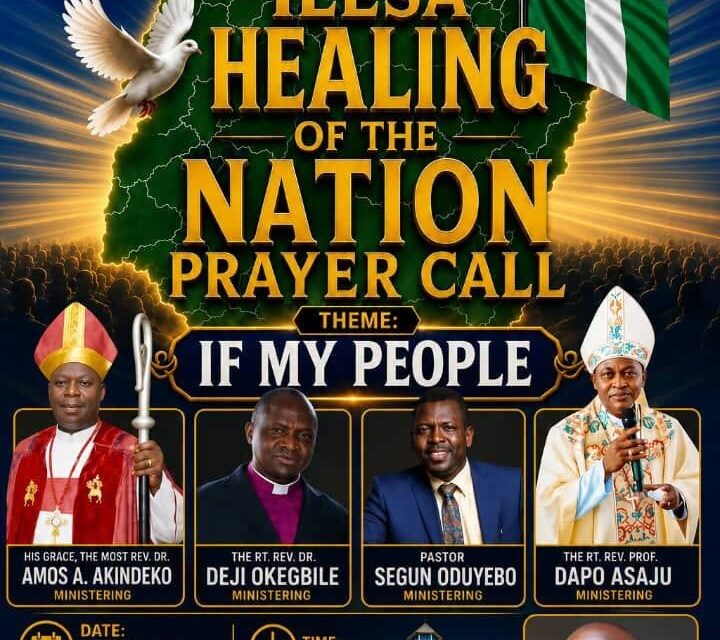
The Good News is that God has promised the in-breaking of His Divine infinity and dynamism over Nigeria. ‘If My People, Ilesa Healing of the Nation Prayer Call is a humble response by God’s people, Christians called by Christ’s name, as directed by the promises of God in Scripture. Indeed, the strength of any nation does not only lie in the home of its people, but the ruin of a nation also begins in the homes of its people. What defines a nation? A nation is defined as a community of people inhabiting a defined territory and organised under an independent government. Government or religious institutions do not function in isolation; they are run by people who carry their religious values from their upbringing. If people are raised with Christ’s humility – integrity, fairness, and empathy- these qualities influence how they act as professionals, leaders, and citizens.
A nation in need of healing connotes people with corrupt values and lifestyles. Religion produces satisfaction around partisan idols shaped by negative values, while Christianity calls us to sanctification through Jesus Christ. The negativity of this value system is first spiritual before becoming a visible national expression. The diagnosis behind the corruption, that is, the negative normalised lifestyle of the people of God, is a lack of humility and surrender to God; hence, it becomes institutionalised, bound by divisions and heavy denominational rules instead of a united mission. Being taught by Jesus on humility and self-awareness, which shapes human deceitfulness of heart and proclivity for wandering, the disciples at the Last Supper asked Jesus, “Is it I?” To be a genuine people of God, humility, which begins in the heart, is the virtue that shapes our personal and corporate holiness
The problem with Nigerian Christianity is not just about prayer without humility, but about homes and religious spaces where corruption and negative traits like indifference, love of money, dishonesty, and lack of discipline are tolerated and negatively influence the church, workplaces, and institutions. Christian humility begins with internal, conscious, heart-level recognition rooted in a posture of complete surrender, self-awareness, and dependence on God. Humility is about shifting focus from wicked mammon ways and lifestyles, loss of biblical authority, a secular mindset, and identity-driven self-promotion to the Gospel of Christ.
Christian humility primarily emphasises heart change as a prerequisite for cultural change. Nigeria’s cultural dilemma gives Christians a missional opportunity to display Christ’s humility, a model to people around the kingdom of God instead of wicked, corrupt ways shaped by partisan idols. In the hostility of our cultural moment, instead of developing an identity as people of God through a united communal Christian formation, we succumb to the virus of corruption – divisions, competing mission frameworks and institutions shaped by worldviews. We are what we love, undergirded by idolatry, thereby transferring our love to false gods and passions to pride. Our idolatry fuels identity denominations and public gatherings that are less about the common good and more about individual performance and benefits. Identity denominations make others feel alienated. Denomination choice is elevated, and others feel like visitors. People attend denominational gatherings not to engage in impactful discipleship but to dominate or kill enemies. Polarisation’s effects on the Nigerian church have been detrimental.
Moses description as “more humble than anyone else on the face of the earth” is a statement about the objective change in circumstances that Moses chose when he willingly left the place of highest regard as prince of Egypt and chose to embrace the circumstances of an enslaved person and be identified with a nation of enslaved people (Num 12:3). Healing of the nation is not abstract but concrete, measurable and tangible that can be perceived with our senses. Healing of a nation first begins and is built through spiritual renewal and commitment of God’s people.
Dr Ibukun Awosika explained that what defines Nigeria’s credibility, especially our spirituality, is the people, not the land, the resources, or the trees. It is important to note that over 50 per cent of Nigeria’s population are Christians, and if Nigeria is sick, the overpopulated percentage is sick. One out of every two Nigerian is a Christian; hence, God is saying to the Nigerian Christians, ‘If My People, who are called by name should humble themselves…’ The main problem with the Nigerian Christian is that our Christianity is highly and socially visible inside the churches and auditoriums but largely absent from where people spend most of their lives. Our ‘faith is separated from work, worship is disconnected from vocation, discipleship unrelated to culture, and salvation irrelevant to the wider world; Christianity has been privatised.’ The missing fruit of the Christian mission in Nigeria today is the cultural transformation: the intentional process of reshaping biblical shared values, behaviours, and spirituality to achieve its missional strategic goals better– the Great Commission of making disciples. Jesus’ teachings in the Sermon on the Mount subvert traditional worldly values—such as power, wealth, and status—in favour of humility, mercy, and justice. When capitalism becomes the sole determinant of a successful culture, there will be a lack of repentance and conversion in the populace. John the Baptist reveals how the individual believer and the institution of the church best pursue efforts to change culture through evangelism. Beyond the present ‘easy-believism,’ Nigeria needs evangelism; the institution of the church has evangelism, and the culture changes for the better because of evangelism (Lk 3).
Believers are called to resist conforming to prevailing cultural norms and instead undergo a complete change of perspective (Rom 12:1-2). Cultural transformation moves beyond crowd gathering or surface-level denominational slogans by addressing the underlying frameworks of scriptural holiness that govern daily discipleship decision-making, collaboration, and accountability. If My People is about biblical narratives that shapes Christian’s engagement with missional potentials to renew and heal our fractured nation. The biblical narrative is that, as people of God, Christians ‘exist for the true King who made us so that we would flourish under His sovereign reign (Gen. 1-2). Sin infected the world, leading to death, war, hatred, and division.’ We develop a posture of humility for others as people of God who exist for the true God and not for the temporal world. People of God are humbled on the account of Jesus’s death that granted us a united identity, mission, and witness. We are people of God with identities defined primarily by our allegiance to Jesus, and ‘this loyalty to Jesus upends our values.’ Scripture orients us to God’s voice, and our heavenly citizenship defines our earthly citizenship, which makes us non-partisan but not neutral. Christian humility enables self-criticism and acknowledges other virtues.
The text from 2 Chronicles contains a remarkable promise from the Almighty God that speaks of forgiveness and healing for nations and for believers. But as awesome a prophetic promise as it is for any nation, many believers forget that it is a conditional promise. When believers meet His conditions, God will honour His promise.
Camp Stephen, Ilesa, in partnership with Wesley 100 International, WIN, are united in one major purpose in promoting unity and healing among Christians in response to Jesus’ priestly prayer (Jn 17:21). One of the practical and visible ways of uniting in Christ is the Ilesa Healing of the Nation Prayer Call with the theme, ‘If My People… 1 Chr. 1:14. Nigeria is a fractured people and nation where corruption is today’s norm, coupled with spiritual decline, economic struggles, terrorist attacks, banditry, and kidnapping. The breakdown of family provides the foundation for many of the problems Nigeria is facing today. The bottom line is that people need healing basically through God’s divine intervention. God did it exactly 96 years ago through the 1930 Oke Oye, Ilesa, from 9th-10th July 1930. While the leadership of the Faith Tabernacle were seeking ecclesiastical direction and reconciliation, God used Apostle Ayodele Babalola to raise a dead child and many of those afflicted with various diseases.
In 1930, Oke-Oye, Ilesa became an ecumenical revival gathering, with thousands of people converted, including traditional worshippers, Muslims, and Christians from various other denominations. The Ilesa Apostolic Council Conference meeting venue turned into a revival meeting. When the hall was no longer comfortable, the meeting shifted to an open-air crusade in the field, where men and women from all walks of life assembled daily for healing, deliverance, and blessings. One day, an administrative meeting turned into weeks of revival meetings, where God used a non-delegate member of the conference, Apostle Ayodele Babalola, to heal and cure hundreds of lepers, blind people, and lame persons.
Amid Nigeria’s current need-based Christianity, there is a need to heal the spiritual deadness for a visible expression of the healing of the nation. If My People … Ilesa Healing of the Nation Prayer Call is a spiritual gathering for believers, uniting in Christ, offering prayer to let God heal and let the nation arise again. If My People … Ilesa Healing of the Nation Prayer Call invite us to Christian discipleship beyond teaching or offering right information, but an intercessory test run, putting it into action, practising and Pushing Until Something Happen (PUSH).
The solutions to the nation’s problems lie not with politicians, reformers, educators, or business leaders, but with God’s people. Today, God’s people are those who worship Him, who accept and follow the Lord Jesus Christ as Lord and Saviour – men and women who are His, not just in name, but in every aspect of their lives. In the darkest of situations, the Church can call out to God, and He will hear. This promise has not expired but remains the key that makes it possible for all His people to take full responsibility for our condition and turn back the spiritual decline.
From the biblical text of this prayer call, let us reflect on God’s given conditions for seeing His healing come to our nation and our lives, and they are all centred in changes that take place in our hearts. Lance Wubbels aptly provides four steps from the biblical text in one of his books, ‘A Time for Prayer,’ published by Inspired for the National Day of Prayer.
Will Humble Themselves: No king sleeps with a crown. Humility means “to bend the knee, to bow down, to be in subjection to.” Humility is when we truly understand how poor and needy we are before God. Those who are humble know what it means to grieve over their sins and the sins of others. Simply put, humility means we are utterly dependent on God, which is the opposite of pride. James 4:16 tells us that “God opposes the proud but gives grace to the humble.”
Being humble is a difficult position, because we all tend to depend on any number of factors other than God only, whether it is our education, our career, our accomplishments and works, or our spiritual résumé. Both individually and as a Church, we need to set aside our pride and humble ourselves. We must be willing to get on our faces before God, come to the cross of Christ with nothing but ourselves, and cry out to Him for a fresh outpouring of His Holy Spirit on our lives and out to the world.
And Pray: To pray means to “ask” when you want God to do something for you and for others. The sovereign God has ordained prayer as the tool to get His work done, and He works in accord with the praying of His people and His own sovereign will. Prayer not only prepares us to do His work, but it is the work that must be done before any other work for the Lord is done. However, we in the Church tend to do almost anything but pray and often treat prayer as a last resort rather than the first thing we should do. We as individuals and the Church must pray. All the major revivals have come because of believers who were serious enough to cry out to God in prayer.
And Seek My Face: God has said, “You will seek me and find me when you seek me with all your heart” (Jeremiah 29:13). God is personal, and we must deal with Him as a person. Too often, we seek the hand of God, which represents His works, instead of the face of God, which represents His nature and who He really is. When we seek His face, we see His holiness and love, which exposes our sin and depravity and selfishness. When we seek His face, we come with adoration and praise and worship, and we are changed and want to love Him more dearly and walk with Him more intimately. When we seek His face, we begin to hear His voice and discover His love and mercy that pardon us of all our sins.
And Turn from Their Wicked Ways: The psalmist said, “If I had cherished sin in my heart, the Lord would not have listened” (Psalm 66:18). If we want to experience the presence of God that changes our lives and the world, we need to get rid of anything that pushes Christ from the centre of our lives. It might be our complacency, apathy, and indifference to what God is concerned about – the poor, the broken-hearted, the exploited, or the unemployed. God hates sin and all forms of wickedness, whether it is abortion, sexual sins, lying, cheating, drunkenness, drug abuse, hatred, jealousy, envy, and fits of rage. And He is not pleased with a Church that refuses to stand out against the many great evils of our day – believers who never fight for what is right, who compromise in an attempt not to offend, who carry no cross and stand for nothing.
Then Will I Hear from Heaven and Will Forgive Their Sin and Will Heal Their Land: From the place of authority, heaven itself, God will “hear,” which means “to listen to a point where you are moved to action.” In other words, He has promised to respond to their prayers. Evangelist Dwight L. Moody said that when God’s people fulfil His conditions, He “brings heaven within speaking distance.”
Standing by Faith
Usually, Satan will try to suggest to you that your prayers were not heard. He will encourage you to look to the problems again and get your eyes off God. He will try to get you to talk as if you are not sure if your prayer is answered. Charles Cowman said, “The devil is not put to flight by a courteous request. He meets us at every turn, contends for every inch, and our progress has to be registered in heart’s blood and tears.”
Be prepared for warfare with Satan. Take firm control of your thought life. Think on positive things (Philippians 4:6-9). By praising God and confessing the relevant truths of the Word, cast down every thought that is contrary to your prayer. Keep speaking what the Word of God says on the issue at stake. “Let us hold unswervingly to the hope we profess, for he who promised is faithful” (Hebrews 10:23). Then, keep believing you will see your prayers answered.
Never lose sight of the fact that there may be specific reasons why a prayer is not answered immediately. God may desire that your faith be exercised and strengthened through your patient waiting on Him. Settle it in your mind that God is always true and faithful to His promises. It may be that your heart is not prepared for the answer to your prayer, but it is on the way.
George Müller said, “Many of the dear children of God stagger, because prayer is not at once answered. And because for weeks, months, and years prayer remains unanswered, they cease to ask God, and thus they lose the blessing that, had they persevered, they would assuredly have obtained. When the heart is prepared for the blessing, it will be given by God.”
If there are delays, let your faith be resolved to trust only God and be more fervent in your prayer. Keep on waiting upon God. Pray on and keep looking for answers. Only be sure you ask for things that are according to the mind of God. Exercise faith in the power and willingness of God to answer your requests. In His time and by His power, God will abundantly prove that your faith was not in vain.